2026-11-12
Understanding What 2,000 Grafts Really Means in a Non-Incision Hair Transplant
This article explains what a 2,000-graft non-incision hair transplant really means, including typical uses, limits, density planning, and cost factors.

Understanding What 2,000 Grafts Really Means in a Non-Incision Hair Transplant
A 2,000-graft non-incision hair transplant
does not mean 2,000 individual strands of hair,
but in most cases it corresponds to roughly 800 to 1,000 follicular units.
The non-incision method
extracts follicular units one at a time,
which keeps scalp damage to a minimum.
That said, what matters most here
is not the graft count itself but the transplant area and placement pattern.
Even with the same 2,000 grafts,
the results can differ completely depending on where they are used.
When a 2,000-graft non-incision hair transplant is used
2,000 grafts is more of a partial-correction amount
than a large-scale transplant.
Typical cases include the following:
Early M-shaped hair loss
When the temples have receded slightly,
it is used to naturally refine the hairline.
Fine-tuning the hairline
When the forehead is slightly wide
or the hairline is uneven,
it is used for cosmetic design refinement.
Density enhancement
In areas where hair is still present
but looks sparse,
it is used to fill in the gaps between existing hairs.
You should also understand the limitations of a 2,000-graft non-incision hair transplant.
This is an important point.
The scope of what 2,000 grafts can address
is more limited than many people expect.
When hair loss has progressed significantly,
trying to cover the entire area with 2,000 grafts
is likely to look underwhelming.
In particular,
a wide forehead,
advanced M-shaped recession,
or crown hair loss.
In such cases,
2,000 grafts alone may not be enough.

Key Density Considerations for a 2,000-Graft Non-Incision Hair Transplant
Many people assume,
“2,000 grafts should fill things in to some degree,”
but the results are not that simple.
In hair transplantation, what matters most
is density planning rather than graft count.
Even with the same 2,000 grafts,
concentrating them in a small area looks natural,
while spreading them over a wide area can make the result look sparse.
That is why, from the start,
a clear strategy is needed for where to concentrate the grafts.
Characteristics of the 2,000-Graft Non-Incision Method
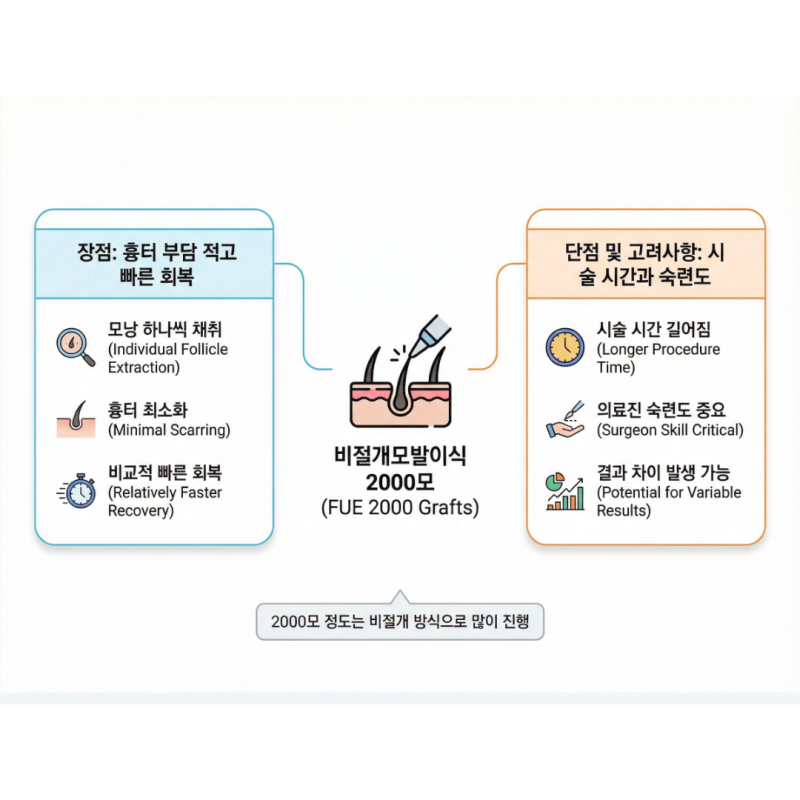
The non-incision method
extracts follicular units one at a time,
so there is less scarring
and recovery tends to be relatively quick.
On the downside,
the procedure can take longer,
and results can vary significantly depending on the skill of the medical team.
Especially for around 2,000 grafts,
the non-incision method is commonly used.
Cost Structure of a 2,000-Graft Non-Incision Hair Transplant
The cost of a 2,000-graft non-incision hair transplant
is not determined by graft count alone.
The factors that determine cost
fall into the following categories:
Extraction method
Procedure time
Design complexity
Aftercare
Even with the same 2,000 grafts,
costs can vary depending on these conditions.

What to Check When Choosing a 2,000-Graft Non-Incision Hair Transplant
This is something you must check.
If you decide based only on graft count,
you are quite likely to regret it.
There are exactly three things to check:
Whether the graft count is sufficient for the treatment area
How the density plan is designed
Whether the hairline design looks natural
If these three are not met,
the results can end up similarly underwhelming,
whether you have 2,000 or 4,000 grafts.
A 2,000-graft non-incision hair transplant
is not a casual starting point,
but a range that requires precise planning.
When the area is narrow, the result looks natural,
but when it is wide, it can look insufficient.
In the end, the key point is simple.
It is not the number 2,000 itself,
but where and how densely the grafts are placed.




Frequently Asked Questions
Does a 2,000-graft non-incision hair transplant mean 2,000 strands of hair?
No, it does not mean 2,000 strands of hair. It most often corresponds to roughly 800 to 1,000 follicular units, and the transplant area and placement pattern affect the results more than the graft count itself.
When is a 2,000-graft transplant used?
It is mainly used for partial correction, such as early M-shaped hair loss, hairline fine-tuning, and density enhancement. It is closer to a partial-correction amount than a large-scale transplant.
Can 2,000 grafts cover overall hair loss?
Generally, no. If hair loss has progressed significantly, trying to cover the entire area with 2,000 grafts is likely to look underwhelming. For a wide forehead, advanced M-shaped recession, or crown hair loss, 2,000 grafts alone may not be enough.
Why is density planning important?
In hair transplantation, density planning matters more than graft count. Even with the same 2,000 grafts, concentrating them in a small area looks natural, while spreading them over a wide area can make the result look sparse.
Does the non-incision method leave less scarring?
Yes. Because follicular units are extracted one at a time, there is less scarring and recovery tends to be relatively quick. However, the procedure can take longer, and results can vary significantly depending on the skill of the medical team.
What should I check when choosing a 2,000-graft transplant?
You should check three things: whether the graft count is sufficient for the treatment area, how the density plan is designed, and whether the hairline design looks natural. Deciding based only on graft count can lead to regret.