2026-11-20
Incisional vs. Non-Incisional Hair Transplant: How Do the Shaved Area and Return-to-Work Timing Differ?
Compares incisional (FUT) and non-incisional (FUE) hair transplants: shaved area, suture line, return-to-work timing, post-op restrictions, and how to choose a method.

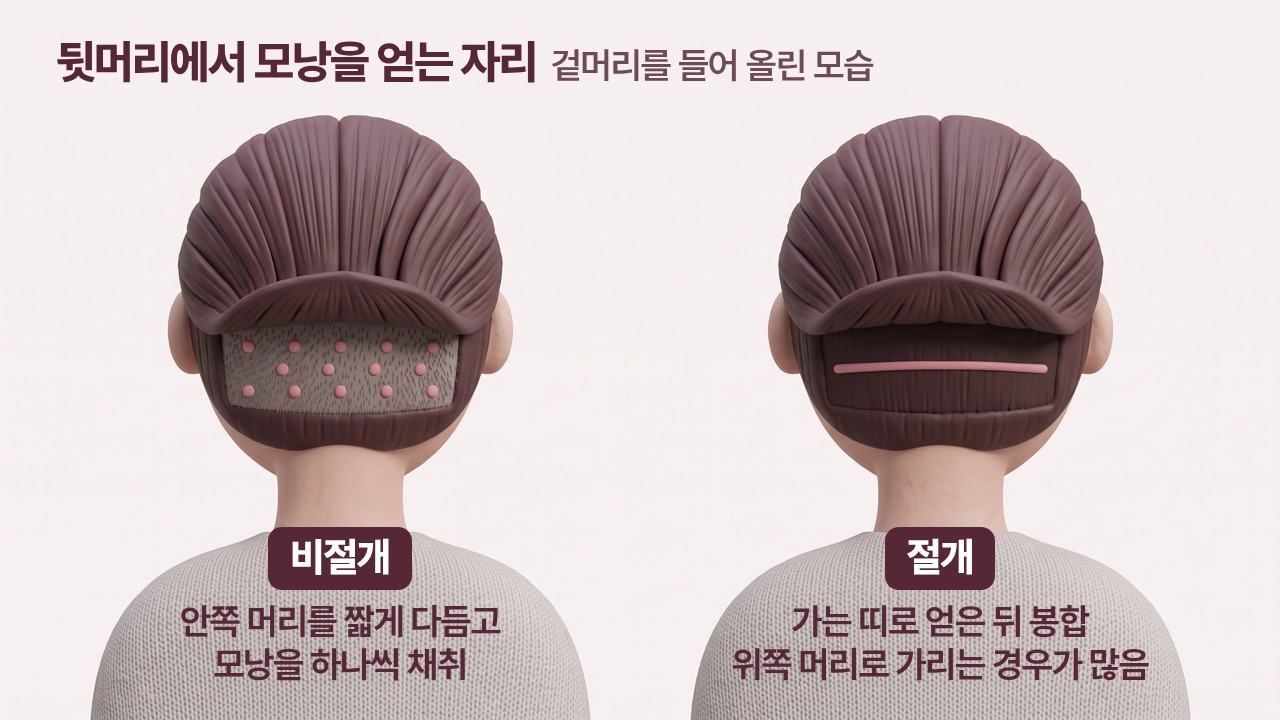
A non-incisional hair transplant leaves the length of the outer hair as is and trims only the hair underneath short to harvest follicles, or it involves shaving part of the back of the head (partial shaving). An incisional hair transplant takes a thin strip of scalp from the back of the head and then sutures it closed; the suture line is often covered by the hair above it, and the area to be trimmed short is decided at your consultation. There is no set date for returning to work. With the non-incisional method, most patients go home the same day and can resume daily life relatively early, depending on the nature of their job. With the incisional method, the timing is decided with your medical team based on how you are healing. With the incisional method, you need to take extra care of the suture area until the stitches are removed, usually around 10–14 days.
Incisional vs. Non-Incisional Hair Transplant: How Do the Follicle Harvesting Methods Differ?
Both methods transplant follicles from the back of the head (occipital area) to the thinning area. Follicles at the back and lower sides of the head are known to be relatively less affected by male pattern hair loss, so this area is used as the donor area (the site from which follicles are taken).
The difference lies in how the follicles are obtained. Non-incisional (FUE) harvests follicles one unit at a time with a micro punch. Incisional (FUT) takes a thin strip of tissue by making a narrow incision in the scalp at the back of the head, divides it into follicular units under a microscope, and then sutures the harvest site. This difference leads to differences in the shaved area and the return-to-work timing.
| Item | Non-incisional hair transplant | Incisional hair transplant |
|---|---|---|
| Harvesting method | Follicles are harvested one unit at a time | A strip is cut from the back of the head and harvested, then the site is sutured |
| Amount that can be transplanted at once | Relatively limited | A large number of follicles can be obtained in one session |
| What remains at the harvest site | Small dot-shaped scars | A thin line-shaped scar |
| Anesthesia | Sedation or local anesthesia | Sedation or local anesthesia |
| Typically considered for | Partial hair loss, such as the hairline or crown | Extensive hair loss where both the crown and the front are thin |
This table summarizes the procedure information from Newcell Plastic Surgery Clinic. These are general guidelines and may vary depending on the transplant area and the condition of your scalp and hair.
Newcell Plastic Surgery Clinic performs both methods and recommends the one that suits you based on the extent of your hair loss, the condition of the follicles at the back of your head, and your lifestyle. The process of the non-incisional method is covered separately in “Understanding the Process and Features of Non-Incisional Hair Transplant for Men.”
Do I Have to Shave My Head for a Non-Incisional Hair Transplant?
What people often think
If I shave the back of my head, won't everyone at work notice?
Non-incisional doesn't necessarily mean shaving a wide area at the back of the head. For non-incisional hair transplants, Newcell Plastic Surgery Clinic uses a method (homepage name: Behind Cut) that leaves the outer hair at its current length and trims only the hair underneath short to harvest follicles. When you let your hair down, the harvest area tends to be covered by the outer hair.
That said, the same method doesn't suit everyone. If you usually keep your hair short, there may not be enough outer hair to cover the area, and the harvest site may show. That is why hair length and transplant extent are considered together, and whether to leave the outer hair or do a partial shave is decided at your consultation.
For reference, if a wide area at the back of the head is shaved, going out in public may feel self-conscious for about 2–3 weeks until the hair grows back. Small dot-shaped scars remain at the harvest sites. They are mostly hidden by the surrounding hair, but they may be visible on closely cropped hair. How the scars heal varies with skin condition and constitution.
How Short Is the Back of the Head Cut in an Incisional Hair Transplant?
In an incisional hair transplant, a narrow strip is taken from the harvest area and then sutured. The suture line is often placed at a height on the back of the head that is covered by the hair above it. If you are keeping your hair at a certain length, it tends to be less noticeable.
How far the hair in the harvest and transplant areas is trimmed short is decided at your consultation, depending on the transplant extent and your hair length.
A line-shaped scar fades over time. However, its width and color vary with constitution and scalp elasticity. The scar may be visible on closely cropped hair, and also if you tie up or lift your hair. That is why your usual hair length and the height of the suture line are discussed together before surgery.
When Can I Go Back to Work After a Hair Transplant?
The return-to-work date varies from person to person. According to the Newcell Plastic Surgery Clinic website, most non-incisional patients go home the same day as the procedure (individual differences apply) and can resume daily life relatively early, depending on the nature of their work. For incisional hair transplants, when to return to light daily activities and work is decided together with your medical team, based on the nature of your work and your recovery. This does not mean that anyone can go to work the day after surgery.
There are three areas to check before going back to work.
- Transplant area — Right after surgery, redness and tiny dot-like scabs may be visible for several days. The tiny scabs usually fall off within 1–2 weeks.
- Swelling — Swelling may move down to the forehead and around the eyes. This applies to both methods.
- Harvest area — With the non-incisional method, dot-shaped harvest sites remain; with the incisional method, there is a suture area. The incision area may feel tight and stiff for a while, and the stitches are usually removed around 10–14 days.
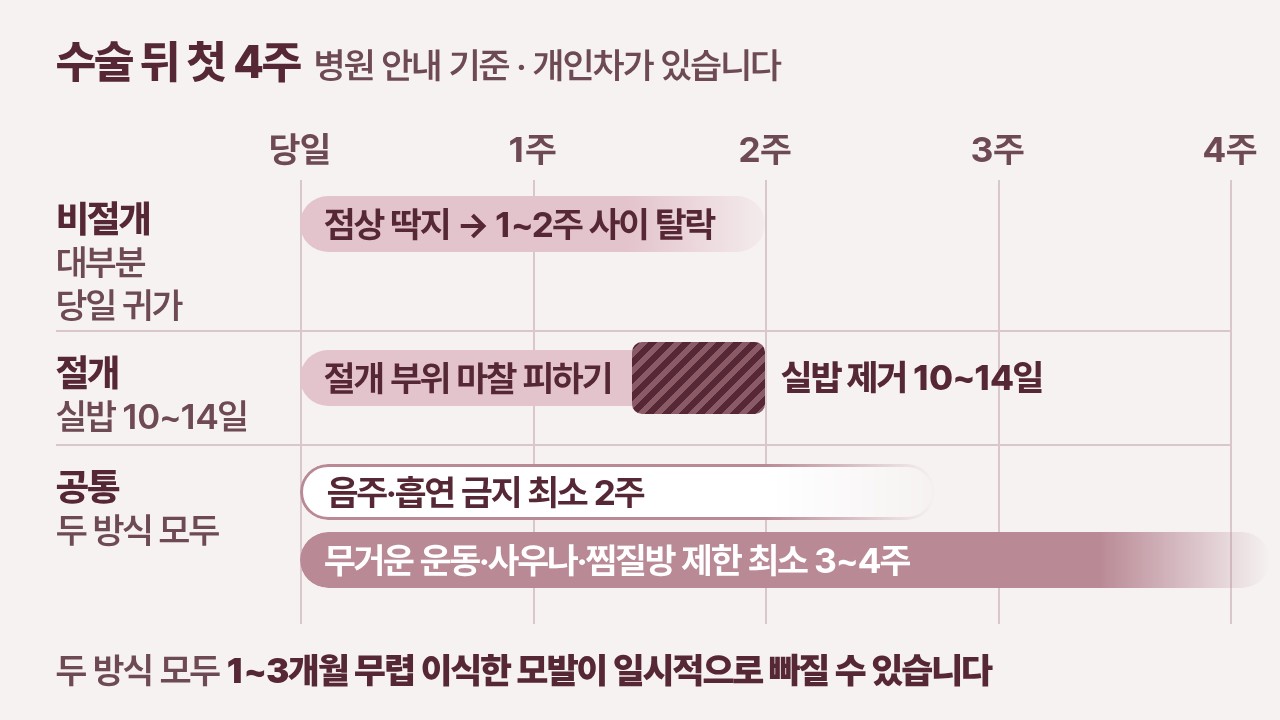
The nature of your work matters too. The transplant area must not be pressed or squeezed, and activities that make you sweat heavily should be avoided for a while. If your job requires a hat or equipment that tightens around the head, or involves heavy sweating, it overlaps with these precautions. In that case, settle your return date with your medical team when you book your surgery date.
How Do the Exercise, Alcohol, and Sauna Restrictions Differ Between the Two Methods?
Alongside the return-to-work date, you should also consider lifestyle restrictions. According to Newcell Plastic Surgery Clinic's guidance, the restriction periods for exercise, saunas, alcohol, and smoking are the same for both methods. The difference lies in how you care for the surgical area.
| Lifestyle guideline | Non-incisional hair transplant | Incisional hair transplant |
|---|---|---|
| Exercise & saunas | Heavy exercise, saunas, and jjimjilbang (Korean bathhouses) restricted for at least 3–4 weeks | Heavy exercise, saunas, and jjimjilbang (Korean bathhouses) restricted for at least 3–4 weeks |
| Alcohol & smoking | Prohibited for at least 2 weeks | Prohibited for at least 2 weeks |
| Surgical area | Do not scratch or rub the transplant area | Avoid strong irritation or friction on the incision area until the stitches are removed (about 10–14 days), and do not scratch the transplant area either |
| Shampoo & medication | Follow the shampooing method and timing you were given | Follow the instructions for taking medication, applying ointment, and when to shampoo |
This table summarizes the post-operative precautions from Newcell Plastic Surgery Clinic. Depending on your recovery, your medical team may advise different actual durations.
If you have a company dinner, a workout commitment, or a business trip coming up, let us know when setting your surgery date. Adjust in advance any plans that overlap with this period.
Symptoms that may occur after surgery
With both methods, the following may occur: swelling that moves down to the forehead and around the eyes, pain, scabbing, redness, itching, temporary shedding of transplanted and surrounding hair, folliculitis, infection, and reduced scalp sensation. With the non-incisional method, dot-shaped scars remain at the harvest sites. With the incisional method, you may have a tight feeling, bleeding, and bruising, and a line-shaped scar remains on the back of the head; scar width varies from person to person.
Contact the clinic right away if redness, swelling, or pain at the transplant, harvest, or incision area keeps getting worse, if blood or pus keeps draining, or if you develop a fever. The degree of graft survival and the final density vary from person to person.
How Do I Decide Which Method Suits Me?
In hair transplantation, how you design the procedure matters more than how many follicles you transplant. Choosing between incisional and non-incisional is part of that design. The Newcell medical team considers the following four things together.
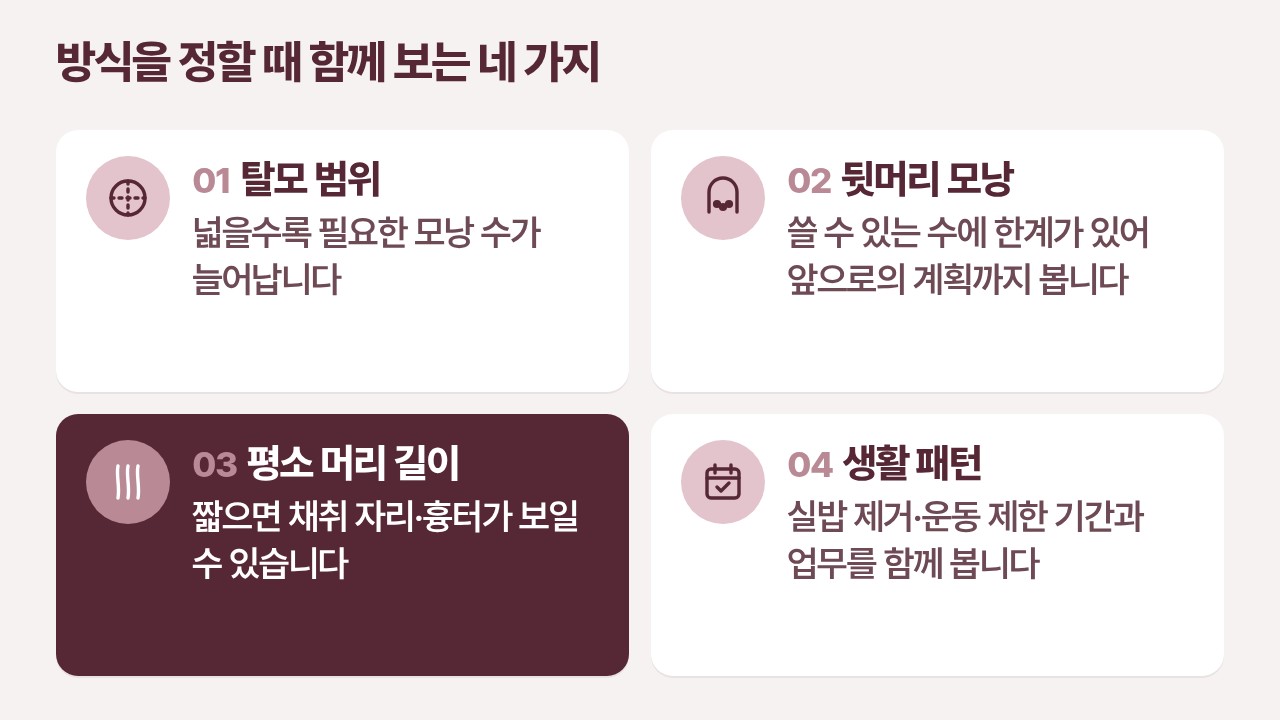
- Extent of hair loss — If you are only filling in part of the hairline or crown, the non-incisional method is also compared. If both the crown and the front are thin and many follicles are needed, the incisional method is considered.
- Follicles at the back of the head — With either method, there is a limit to the number of follicles that can be used from the back of the head. That is why Newcell Plastic Surgery Clinic plans for the future from the first consultation. Because hair loss may progress further, whether to combine medication or hair loss management is also decided at that time.
- Usual hair length — The shaved area and the height of the suture line are set to match the hair length you will keep after surgery.
- Lifestyle — Your life and work after surgery are considered together. Check in advance that the stitch removal and exercise restriction periods do not overlap with important events.
If your hair is thinning evenly all over, a transplant may not come first. In that case, we diagnose the cause first and may recommend treatment before a transplant.
Whichever method is used to obtain the follicles, the recipient area is designed region by region. Single-follicle grafts are placed along the very front row of the hairline and at the boundary with the fine hairs, and 2–3-follicle grafts are placed in the inner areas that need density, such as the crown or the center of the front. Dr. Heo Jun-mo, advisory physician, specializes in customized hairline design. Dr. Heo explains, “Relatively thicker hair should be placed on the crown and finer hair on the hairline to achieve both density and a natural look.” The linked non-incisional hair transplant guide page has more on follicular-unit placement and design standards for men and women.
Incisional and Non-Incisional Hair Transplant: Frequently Asked Questions
Is it very painful during or after hair transplant surgery?
Both methods are performed under sedation or local anesthesia, and the anesthesia method is decided at your consultation. The anesthetic injection may sting, and after surgery you may feel tightness or stiffness for a few days, which is managed with prescribed medication. How much you feel varies from person to person.
Can I wear a hat after a hair transplant?
For non-incisional hair transplants, Newcell Plastic Surgery Clinic's precautions say to wear a hat loosely until the follicles settle and not to press or tighten the transplant area. For incisional hair transplants, we advise avoiding strong irritation or friction on the incision area until the stitches are removed. Follow your post-operative instructions on when you can wear a hat and what kind.
What if the transplanted hair falls out 1–3 months after I go back to work?
If hair falls out a month or two after you return to work, it may be the temporary shedding that occurs during this period. Around 1–3 months after surgery, transplanted hair may temporarily fall out, and during this time the follicles are settling in beneath the scalp. New hair begins to grow in thinly around 4–6 months, and its thickness and density settle in over 9–12 months. The speed and final density vary from person to person. If redness, swelling, and pain also worsen, contact the clinic.
My area is wide and I'm worried about an incision scar. How is the method decided?
A wide area does not automatically mean the incisional method. At your consultation, the method is chosen by considering together the amount and density of follicles at the back of your head, scalp elasticity, your usual hair length and lifestyle, and how much the scar concerns you. If you are worried about scarring, mention it first at the consultation. If your hair loss is still progressing, medication and hair loss management may be reviewed before a transplant.
What we do at the consultation
Before choosing a method,
we look at the extent of your hair loss and the back of your head
- Check the stage and type of hair loss
- Check the condition of the follicles at the back of the head and scalp elasticity
- Discuss the shaved area to match your hair length and transplant extent
- Guidance on recovery by stage and on precautions
This is not a consultation that assumes you will have a procedure; we first check your current condition and then guide you to a suitable method. After surgery, we check your progress on schedule. Results and recovery may vary from person to person.

Director Baek Seung-chan of Newcell Plastic Surgery Clinic is a board-certified plastic surgeon and has served as an adjunct professor of plastic surgery at the Catholic University of Korea College of Medicine and Korea University College of Medicine.
Consultation and Appointments
| Phone | 1533-1701 |
|---|---|
| Hours | Mon–Fri 10:00 – 19:00 (last check-in 18:30)
Closed Saturdays and Sundays · By appointment only. |
| Address | 4F, 417 Dosan-daero, Gangnam-gu, Seoul (Cheongdam-dong, FIRST LIGHT Tower) |
| Website | newcell.kr |
| KakaoTalk | You can send an inquiry using the ‘KakaoTalk Inquiry’ button on the homepage. |
#HairTransplant #NonIncisionalHairTransplant #IncisionalHairTransplant #IncisionalVsNonIncisionalHairTransplant #ReturnToWorkAfterHairTransplant #NonIncisionalHairTransplantShaving #BehindCut #BackOfHeadScar #Hairline #NewcellPlasticSurgeryClinic
Advertisement