2026-11-19
How to Choose a Hair Transplant Clinic for Female Crown Hair Loss — 5 Criteria to Check Before Your Consultation
Five criteria to check before choosing a hair transplant clinic for female crown hair loss, including case experience, surgical options, aftercare, and quote transparency.
How to Choose a Hair Transplant Clinic for Female Crown Hair Loss — 5 Criteria to Check Before Your Consultation

"They say there's no solution for the crown area..."
This is a phrase that women dealing with crown hair loss often come across online. Many reviews also describe visiting a clinic only to be advised on scalp treatments or scalp micropigmentation instead of a hair transplant.
However, depending on their condition, some women with crown hair loss can improve with a hair transplant, and much of the difference in results is determined by the choice of clinic rather than the surgery itself. This article outlines five criteria to check when choosing a clinic for a female crown hair transplant.
1. Why Is a Hair Transplant Considered Difficult for Female Crown Hair Loss?
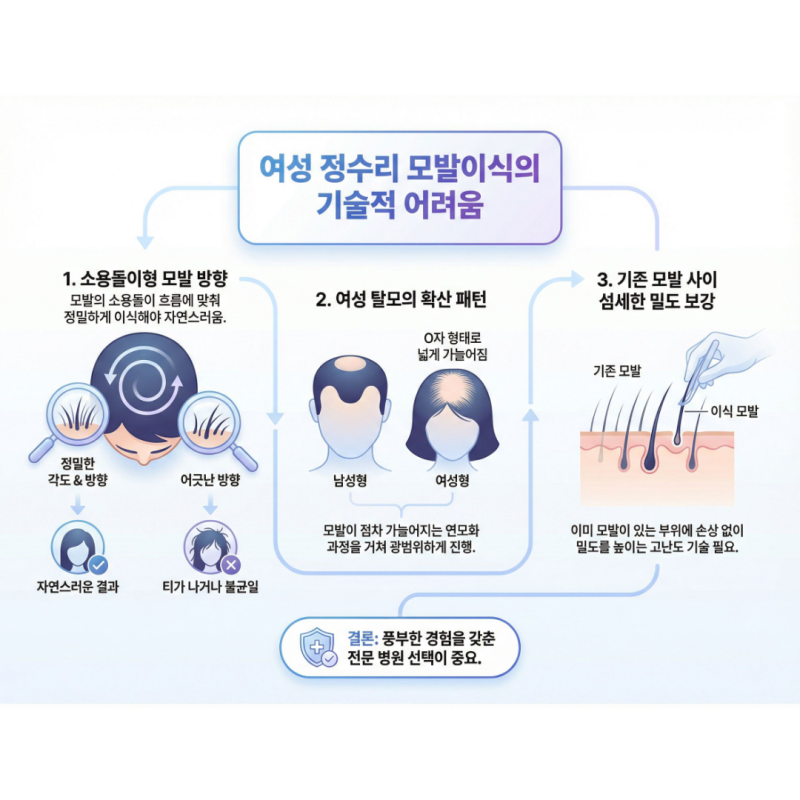
A crown hair transplant is technically more demanding than transplants in other areas. The crown is where hair grows in a swirling pattern from multiple directions, so the direction and angle of transplanted hairs must be precisely matched to the existing hair flow to achieve a natural result. Even a slight misalignment can make the transplanted area noticeable or leave density looking uneven.
Female crown hair loss follows a different pattern from male hair loss. While male pattern hair loss progresses along the M-shaped hairline and the crown, female crown hair loss tends to spread more broadly in an O-shaped pattern, passing through a process of gradual miniaturization in which hair becomes progressively thinner. Because grafts are often added to areas that still have hair, a delicate approach is needed to increase density without damaging the existing hair.
For this reason, there can be a significant difference in results between clinics with ample experience treating female crown cases and those without it.
2. Criterion 1 — Does the Clinic Have Sufficient Experience with Female Crown Cases?
When choosing a hair transplant clinic, the first thing to check is its experience with female crown cases. Many hair transplant clinics specialize in male M-shaped and frontal hair loss, and relatively few clinics have proven expertise in female crown cases.
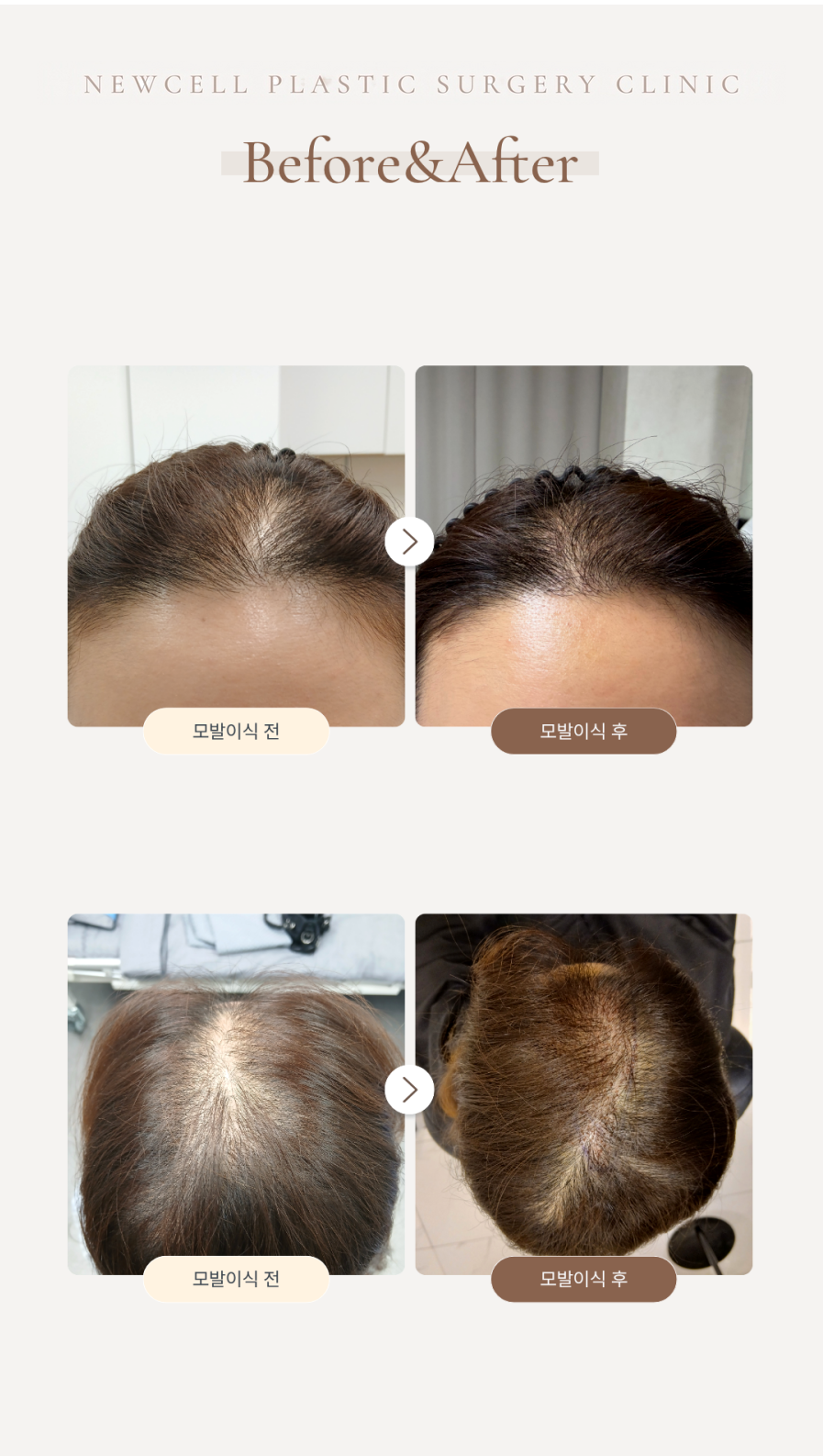
Before your consultation, it helps to look at before-and-after photos of female crown surgeries on the clinic's website or in hair loss communities. When reviewing these photos, it's best to focus on images taken 6 months to 1 year after surgery rather than immediately afterward.
This is because the final result of a hair transplant can only be assessed about one year after surgery, and early photos alone make it hard to judge how well the grafts have actually taken. During your consultation, it's a good idea to ask the doctor directly how many female crown procedures they have performed and whether they have treated cases with a similar hair loss pattern.

3. Criterion 2 — Does the Clinic Offer Both Incision and Non-Incision Options?
Hair transplant techniques are broadly divided into the incision-based method (FUT) and the non-incision method (FUE). In FUT, a strip of scalp is removed from the back of the head, the follicles are harvested from it, and the wound is then closed. This method is advantageous for large-volume transplants but may leave a linear scar. FUE harvests follicles one by one, minimizing scarring and allowing faster recovery, but the procedure takes longer and tends to cost more.
When choosing a surgical method, the key question is not which technique is absolutely superior, but which one is better suited to the patient's scalp condition. If scalp elasticity is poor, closing the incision can reduce blood circulation and affect graft survival. If there is little hair at the back of the head, harvesting too many follicles with the non-incision method can make the donor area look thin. A clinic skilled in both incision and non-incision techniques can recommend the approach that fits the patient's condition without bias.
Compared with a clinic that recommends only one technique, a clinic that explains the pros and cons of both and proposes a surgical plan based on the patient's scalp elasticity, extent of hair loss, and lifestyle is generally more trustworthy.

4. Criterion 3 — Does the Clinic Have a System for Graft Survival Care and Aftercare?
The outcome of a hair transplant is determined not on the day of surgery, but through the aftercare that follows. The graft survival period, during which transplanted follicles take root in the scalp, lasts about two weeks after surgery, and care during this time has a direct impact on graft survival rates. During this period, you'll need to use a foam-based shampoo without rubbing the transplanted area, take care when wearing a hat, and avoid hair-fiber powders and wigs.
When selecting a clinic, it's important to confirm that it has a well-structured aftercare program. Check in advance whether there is a schedule of regular follow-up exams after surgery, whether there is a system for monitoring graft survival progress, and whether the criteria for a touch-up procedure in case of poor graft survival are clearly defined. If all services end on the day of surgery with no post-operative follow-up, it may be difficult to get help when problems arise.

5. Criterion 4 — Be Wary of Excessive Graft Recommendations and Unusually Low Prices
One pattern that often appears in hair transplant consultation reviews is how widely the recommended graft count varies from clinic to clinic. For patients with the same scalp condition, one clinic may recommend 1,500 grafts while another suggests more than 3,000. Recommending more grafts than necessary drives up surgical costs, and excessive harvesting from the donor area (the back of the head) can also affect donor density.
A hair transplant is a demanding procedure in which a surgeon and a specialized team handle thousands of follicles over several hours. If the price is unusually low, keep in mind that something may have been cut, whether it's the medical team's skill level, the follicle handling system, or the quality of aftercare. When comparing quotes from multiple clinics, it's wise to look not just at the price, but also at the basis for the graft count and the logical soundness of the surgical plan.

6. What to Do Before Choosing a Clinic
Before choosing a clinic, you first need to understand the state of your own hair loss. Female crown hair loss can have a range of causes, including hormonal changes, nutritional deficiencies, and telogen effluvium (shedding-phase hair loss). Depending on the cause, medication or scalp treatment may need to come before a hair transplant. If you have surgery while hair loss is still actively progressing, the areas that were not transplanted may continue to thin, which can change the overall result.
Real surgery progress photos and reviews shared in hair loss communities can be useful references, but since individual results vary widely, they should not be treated as an absolute standard. Remember that a careful choice of clinic is the most important factor in determining the outcome of your surgery.


Frequently Asked Questions
Is a hair transplant possible for female crown hair loss?
Depending on the condition, some cases of female crown hair loss can be improved with a hair transplant. However, because female crown hair loss follows a different progression pattern from male hair loss, results can vary greatly depending on the clinic's experience. Depending on the cause, medication or scalp treatment may also be needed first.
When can I see the final result of a hair transplant?
The final result can only be assessed about one year after surgery. Because it's difficult to judge actual graft survival from early photos alone, before-and-after photos are best evaluated at the 6-month to 1-year mark after surgery.
How long is the graft survival period after a hair transplant?
The graft survival period lasts about two weeks after surgery. During this time, care is required, such as using a foam-based shampoo without rubbing the transplanted area, being careful when wearing a hat, and avoiding hair-fiber powder and wigs. This care directly affects graft survival rates.
Which is better: the incision method or the non-incision method?
Neither method is absolutely superior. What matters is choosing the one that suits the patient's scalp condition. The incision method is advantageous for large-volume transplants but may leave a linear scar. The non-incision method minimizes scarring and allows faster recovery, but it takes longer and tends to cost more.
How should I interpret different graft count estimates from different clinics?
Rather than focusing on price alone, check the basis for the graft count and whether the surgical plan is logically sound. Recommending more grafts than necessary raises costs and can affect donor-area density. If the price is unusually low, consider the possibility that aspects such as the medical team's skill or aftercare have been cut.
How can I verify a clinic's female crown experience during a consultation?
It helps to first look at before-and-after photos of female crown surgeries on the clinic's website or in hair loss communities. During your consultation, ask the doctor directly how many female crown surgeries they have performed and whether they have treated cases with a similar hair loss pattern.