2026-11-20
How Long Does Swelling Last After a Hairline Hair Transplant? A Day-by-Day Recovery Timeline
Swelling after a hairline hair transplant usually peaks around days 3 to 4, noticeably eases by days 6 to 7, and is mostly gone by two weeks. See the full timeline.

How Long Does Swelling Last After a Hairline Hair Transplant? A Day-by-Day Recovery Timeline
Why swelling is worse on days 3 to 4 than right after surgery
Most people who receive a hairline hair transplant are surprised not on the day of surgery, but on days 3 to 4 after the procedure. The swelling may look worse than the day before, and the puffiness that was only on the forehead yesterday seems to have spread down to the area under the eyes or the cheeks. This is not an abnormal reaction. It is a normal part of recovery.
During surgery, a local anesthetic and a buffered solution (tumescent solution) are injected into the scalp. After the procedure, this fluid slowly drifts downward under the influence of gravity, causing swelling in the face.
In addition, when the scalp tissue is irritated by surgery, the body's healing response dilates the blood vessels in that area and pushes plasma components into the surrounding tissue. This process adds to the swelling, which peaks around days 3 to 4 after surgery.
In other words, the typical recovery pattern is for swelling to get worse a few days after surgery, not right after it.
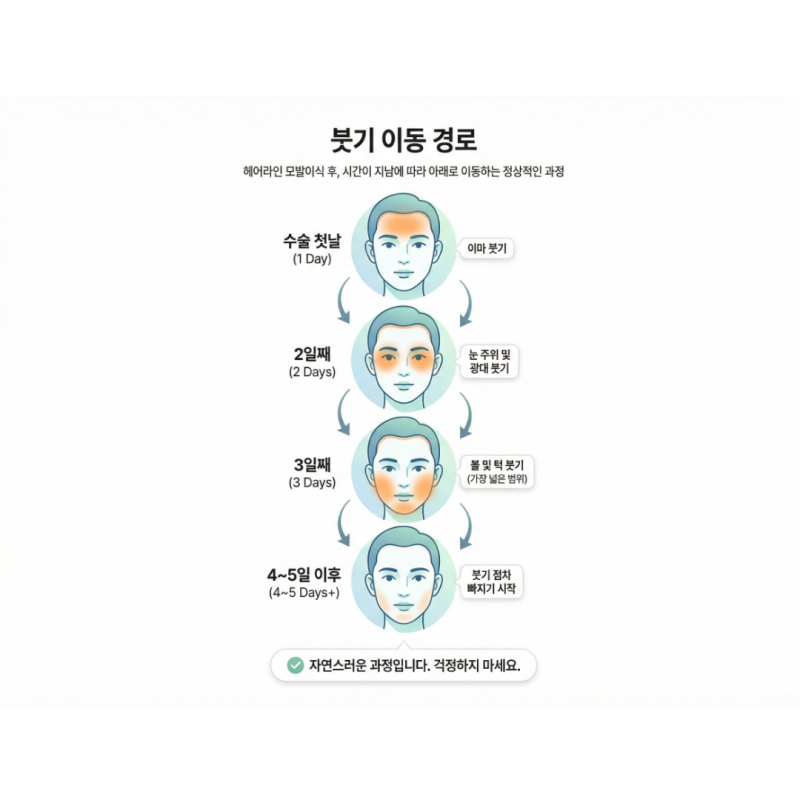
Swelling pathway — it is normal for swelling to start at the forehead and move down to the chin
After a hairline hair transplant, swelling does not stay in one place. It moves downward over time. The typical pathway looks like this.
On the first day after surgery, the swelling mainly appears on the forehead, because that is the area closest to the transplant site.
By day 2, the swelling has moved down with gravity to the areas around the eyes and the cheekbones. Some patients also have puffy eyelids, and some describe their field of vision as feeling restricted.
On day 3, the swelling moves further down toward the cheeks and chin. This is the period when the swelling covers the widest area.
It may feel as though your whole face has changed, but this is a temporary effect.
From days 4 to 5, the swelling gradually begins to subside.
This pattern of movement happens naturally as the tumescent solution and tissue fluid drain downward under gravity. If you notice these symptoms, do not assume something has gone wrong with the surgery.
Day-by-day swelling recovery timeline (Days 1 to 2 weeks)
Below is a day-by-day summary of recovery after surgery.
- Surgery day to Day 1: Initial swelling begins mainly on the forehead, and scabs start to form on the transplant area.
- Days 2 to 3: Swelling progresses in earnest and often spreads to the eyes and cheekbones. This is the peak swelling period.
- Days 4 to 5: Swelling covers the widest area, but it starts to decrease gradually.
- Days 6 to 7: In most cases, swelling noticeably decreases. By the end of the first week, recovery is generally at a level that allows daily activities.
- Week 2: Swelling has nearly disappeared, and scabs fall off naturally.
However, depending on your skin condition and the number of follicles transplanted, mild swelling may remain for up to two weeks.
The key is to distinguish between the point when you can return to daily life and the point when swelling has completely gone.
Even before swelling has fully disappeared, returning to work or running light errands is generally possible from around days 5 to 7.
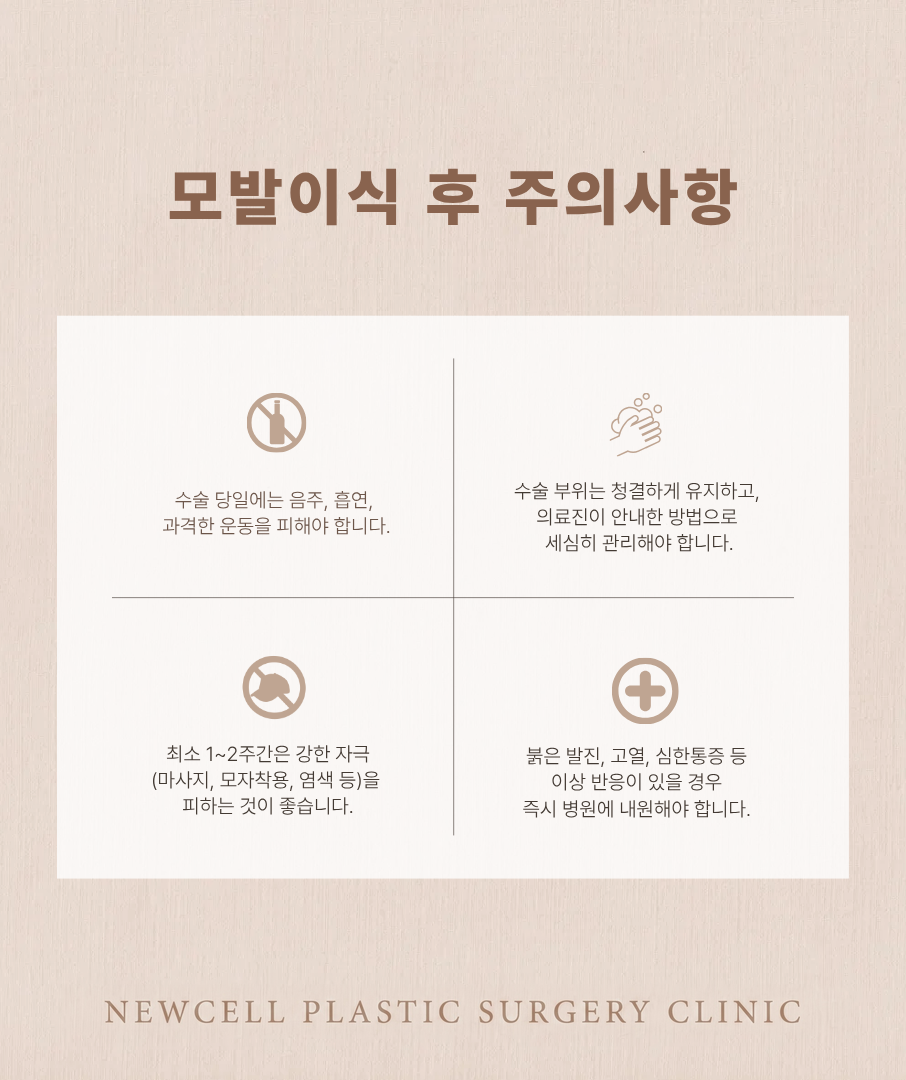
Tips to reduce swelling faster — cold compress, sleeping position, and diet
How severe and how long the swelling lasts can vary depending on how you care for yourself after surgery.
Cold and warm compresses should be applied at the right times. A cold compress is effective on days 1 to 3 after surgery. Placing a towel filled with ice or an ice pack lightly on the forehead can help constrict the blood vessels and limit the spread of swelling. However, never apply direct pressure to the transplant area.
From day 4, it is better to switch to a warm compress. Warm compresses promote blood circulation and help the body quickly absorb swelling that has already formed.
Sleeping position also matters. For the first two days after surgery, use a special pillow that supports your neck, or sleep with your upper body raised above the level of your heart. This can reduce the movement of fluid toward the face. Avoid positions that involve bending your head forward or lying flat for long periods, as these can make swelling worse.
Diet also affects how quickly you recover. For one to two weeks after surgery, it is best to avoid salty and spicy foods. Excess sodium prevents the body from expelling water, which can keep swelling lingering for longer.
Drinking alcohol and smoking cause blood vessels to constrict and interfere with tissue recovery, so both should be avoided for at least two weeks.
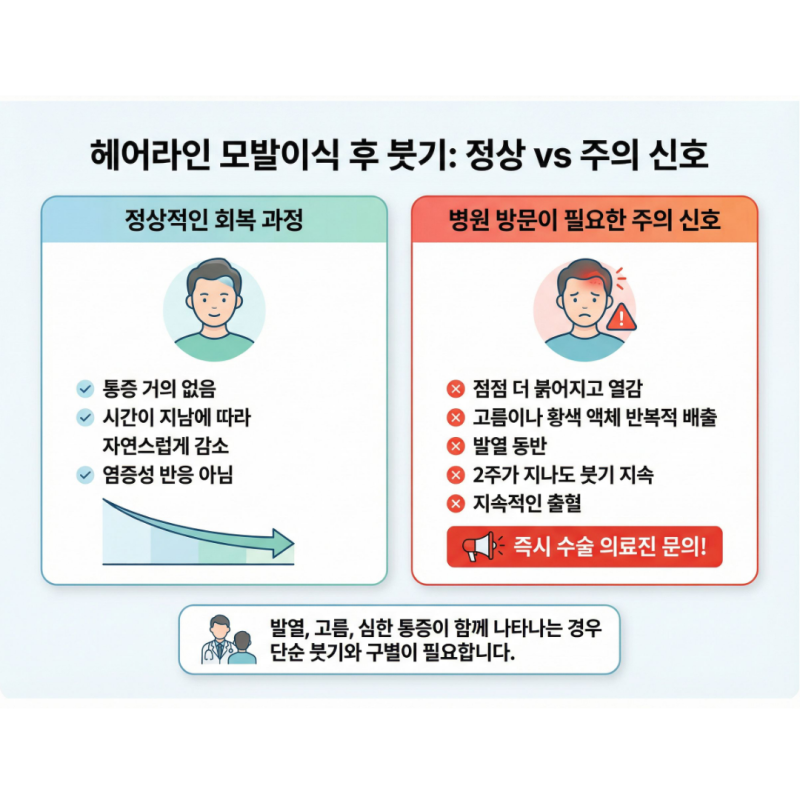
When to see a doctor — normal swelling vs. warning signs
Swelling after a hairline hair transplant is, in most cases, a normal part of recovery. However, if the following symptoms appear, an infection or another adverse reaction should be considered.
Normal swelling causes little or no pain and gradually decreases over time. On the other hand, if the surgical area becomes increasingly red, feels hot, or repeatedly leaks pus or a yellowish fluid, folliculitis or a bacterial infection may be suspected.
If you develop a fever, if the swelling has not decreased at all after two weeks, or if the surgical site keeps bleeding, contact the medical team that performed your surgery right away.
Swelling itself is not an inflammatory reaction. However, when it occurs together with fever, pus, or severe pain, it should be distinguished from simple swelling.
What comes next after the swelling goes down?
From about week 2, once the swelling has disappeared, the shedding phase of the transplanted hairs begins in earnest.
Between about 2 weeks and 1 month after surgery, the transplanted hairs fall out. This does not mean the transplant has failed. It is a normal part of the hair growth cycle that makes room for new hair to grow.
The follicles remain securely anchored in the scalp, and after this phase passes, new hair gradually begins to grow.
From 1 to 4 months after surgery is a dormant phase, during which the transplanted hairs remain in a shed state. Many people feel anxious because the scalp looks similar to how it did before surgery, but this is also a normal course.
After about four months, new hair begins to grow, and the final result is typically visible about one year after surgery.
Swelling is a short-term issue that generally resolves within two weeks of surgery. It is important to remember, however, that true recovery takes place over the course of a full year.


Frequently Asked Questions
When is swelling usually at its worst after a hair transplant?
Swelling is usually at its worst around 3 to 4 days after surgery. It is normal for swelling to increase a few days after the procedure rather than right afterward, and this is not an abnormal reaction.
Is it normal for swelling to move from the forehead down to the area under the eyes or the cheeks?
Yes, this is a normal part of recovery. Over time, swelling moves downward with gravity from the forehead toward the areas around the eyes, the cheeks, and the chin. This is a natural process in which the tumescent solution and tissue fluid flow downward.
When does swelling completely go away after a hairline hair transplant?
Swelling usually almost completely disappears by two weeks after surgery. However, depending on your skin condition and the number of follicles transplanted, mild swelling may remain for up to two weeks.
When can I return to work with swelling still present?
In most cases, you can return to work or go out for light activities from about 5 to 7 days after surgery. Because you can resume daily life before the swelling has completely gone, it helps to distinguish between the time you can return to your routine and the time the swelling fully disappears.
When should I switch from cold compresses to warm compresses after a hair transplant?
It is generally recommended to use cold compresses on days 1 to 3 after surgery and switch to warm compresses from day 4. Avoid applying direct pressure to the transplant area.
Is it a failure if the transplanted hairs fall out?
No. The shedding of transplanted hairs is not a sign of failure. It is a normal hair growth cycle that makes room for new hair. Transplanted hairs usually shed about 2 weeks to 1 month after surgery, new hair begins to grow after about 4 months, and the final result is typically visible about one year after surgery.