2026-11-08
Female M-Shaped Forehead Hair Transplant: Why It Worries Women Even Without Hair Loss
An M-shaped forehead can concern women even without hair loss. This guide covers causes, how female hairline hair transplants work, and what to check when choosing a clinic.

Female M-Shaped Forehead Hair Transplant: Why It Worries Women Even Without Hair Loss

Have you ever noticed that the sides of your forehead look increasingly sunken every time you check the mirror?
It becomes even more noticeable when your hair is tied back, and many people start to feel self-conscious when their bangs seem thinner.
An M-shaped forehead in women can be caused by hair loss, but it can also be the natural shape of the hairline from birth.
Either way, hair transplants can now create a natural-looking correction, so more and more people are considering it.
Today, we'll walk you through female M-shaped forehead hair transplants step by step.
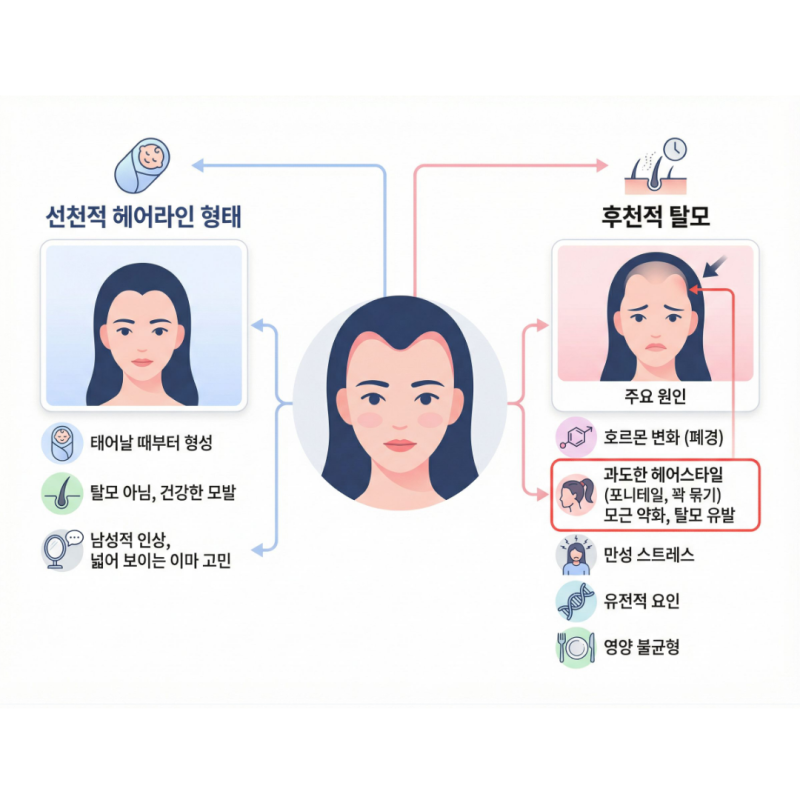
What Causes an M-Shaped Forehead in Women?
An M-shaped forehead in women generally falls into two categories.
The first is a congenital hairline shape. The hairline has been formed this way since birth, with the sides of the forehead either angular or indented.
Since there is no hair loss, the hair itself is healthy, but many people are concerned because their overall look seems more masculine or their forehead appears wider.
The second is hair loss caused by acquired factors. In women, an M-shaped pattern of hair loss can develop for the following reasons:
- Hormonal changes (decline in estrogen after menopause)
- Excessive hairstyling (ponytails, repeatedly tying hair tightly)
- Chronic stress
- Genetic factors
- Nutritional imbalance
In particular, a long-standing habit of pulling hair back tightly can weaken the hair roots along the hairline and lead to an M-shaped pattern of hair loss.
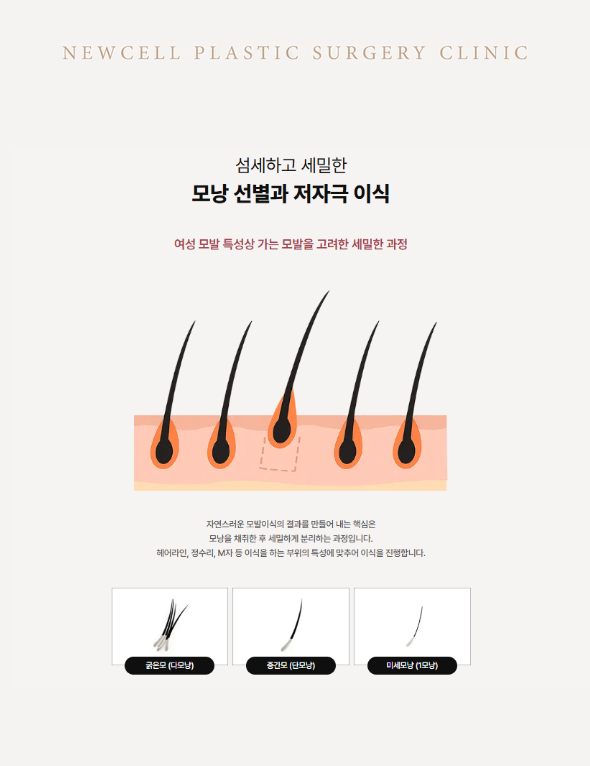
How Does a Female M-Shaped Forehead Hair Transplant Work?
A hair transplant involves harvesting follicles from areas less affected by hair loss, such as the back of the head, and implanting them one by one into the M-shaped recessed areas of the forehead.
Transplanted hair sheds once shortly after surgery, then begins to regrow about 3 to 6 months later. After about a year, you can see a natural-looking hairline.
The most important factor in a female hair transplant is a natural-looking hairline design.
The finest single hairs are placed at the front, and thicker hairs are placed progressively toward the back to create a natural gradient.
In addition, the design needs to be tailored to each person's face shape, forehead proportions, and facial features to achieve a result that doesn't look unnatural.
Non-Incision vs. Incision: Which Method Is Right?
Female M-shaped forehead hair transplants are mostly performed using the non-incision (FUE) method.
With the non-incision method, follicles are harvested one at a time without cutting the scalp, so scarring is minimal and recovery tends to be quick.
For hairline corrections that don't involve a large transplant area, the non-incision method alone is often sufficient.
When a large number of grafts is needed, the incision method may be chosen, or both methods may be combined.
The most accurate way to determine which method suits your condition is through a consultation with a specialist.

Female M-Shaped Forehead Hair Transplant: Who It's Suited For
- Those with naturally angular sides to the forehead
- Those whose hairline has receded, making the M-shape more pronounced
- Those who are still bothered by the indentations even when they wear their bangs down
- Those who find it difficult to wear tied-back or updo hairstyles
- Those who find it inconvenient to cover their hairline with makeup
If hair loss is in its early stages, medication may be tried first. For more advanced cases, a hair transplant may be the most realistic option.

Be Sure to Check These When Choosing a Clinic
For a female M-shaped forehead hair transplant, the delicacy of the hairline design largely determines the outcome.
Here are the points to check:
1. Does the clinic have extensive experience with female hairline correction?
Male pattern hair loss transplants and female hairline corrections require different design approaches, so choose a clinic with plenty of experience treating female patients.
2. Can hairs be placed according to thickness?
Depending on whether the hair is a single hair or vellus hair, it needs to be placed in the appropriate position to look natural.
3. Is the pre-surgery design consultation thorough enough?
The hairline shape should be thoroughly discussed before surgery. Communication with the medical team during the design stage directly affects the outcome.
4. Is there an aftercare period?
Check whether the clinic has an aftercare system that monitors how the transplanted hair takes root.

An M-shaped forehead in women can be corrected even without hair loss.
A hair transplant that creates a natural hairline often makes the forehead look smaller and softens the overall impression.
However, results can vary depending on your scalp condition, the number of grafts, and the design skills of the medical team.
We recommend choosing the approach that suits your condition after a thorough consultation.
※ Hair transplant is a medical procedure, so results may vary depending on individual scalp condition, progression of hair loss, and overall health. Be sure to make a decision only after a thorough consultation with a specialist.


Frequently Asked Questions
Can an M-shaped forehead occur in women without hair loss?
Yes, an M-shaped forehead can appear even without hair loss. Some people have a congenital hairline with angular or indented sides to the forehead. In these cases, the hair itself is healthy, but the overall impression or forehead width may still be a concern.
What causes an M-shaped forehead in women?
It broadly falls into two types: a congenital hairline shape and hair loss due to acquired factors. Acquired causes include a decline in estrogen after menopause, excessive hairstyling, chronic stress, genetic factors, and nutritional imbalance.
How is a female M-shaped forehead hair transplant performed?
Follicles are harvested from areas less affected by hair loss, such as the back of the head, and implanted one by one into the recessed M-shaped area of the forehead. Transplanted hair sheds shortly after surgery and begins to regrow after about 3 to 6 months. A natural-looking hairline can typically be seen after about a year.
What methods are commonly used for female hair transplants?
Most are performed using the non-incision (FUE) method. Because follicles are harvested one at a time without cutting the scalp, scarring is minimal and recovery is relatively quick. For hairline corrections with a small transplant area, the non-incision method alone is often enough.
Why is hairline design important in female hair transplants?
Natural hairline design is the most important factor. The finest single hairs are placed at the front, with thicker hairs toward the back to create a natural gradient. The design should also be personalized to each person's face shape, forehead proportions, and facial features.
What should you check when choosing a hair transplant clinic?
Check four things: experience with female hairline corrections, whether hairs can be placed according to thickness, whether the pre-surgery design consultation is thorough, and whether there is an aftercare period. The delicacy of the hairline design largely determines the outcome.